Hugh Botting was born on 26 June 1945 in London and settled in Australia in 1958. He attended the Redcliffe High School before graduating with an Honours degree in Arts and in 1970 a Law degree from The University of Queensland. He served as clerk to two former members of the District Court of Queensland, Judges Seaman and Mylne. He was called to the Bar in December 1970. After many years as an examiner in criminal law for the Barristers’ Board and long service to the Bar Association of Queensland, in 1988 he was elected the first honorary life member of the Bar Association. He was appointed a judge of the District Court on 3 May 1989. He retired from the court in 2015, upon reaching statutory retiring age and after serving for over 26 years. In this article, Hugh reflects on his time serving – as a clerk, barrister and judge – in circuit courts. The Supreme and District Courts (in particular the latter) continue to service a raft of provincial cities and towns where there is no resident judge. Much of that litigious work – in particular in the civil space – is now undertaken by the highly competent regional members of the Queensland Bar.
In a State as large as Queensland circuit work has long been a feature of life at the Bar and on the Bench. Six years after separation from New South Wales the Queensland Parliament passed the District Court Act Amendment Act. Central to the parliamentary debates at the time was the need for the courts to reach into the farthest parts of the new State.1 160 years later – notwithstanding the enormous technological changes that have occurred – circuits to regional centres remain of vital importance. They can provide timely access to justice, and can contribute to the continued presence of legal professionals in the regions of this decentralised State.

Judge Gibney
When I was a Judge’s clerk in the late 1960’s I heard stories from barristers – such as Vince Fogarty, Jim Gibney (later Judge Gibney), Bill O’Connor and Judge Ted Moynahan – of circuit life. A common theme was an emphasis on the collegiate camaraderie of the Bar. I remember Fogarty telling me of his taking a train to Roma to appear in a murder trial. He had been delayed before leaving and arrived much later than he had anticipated. At his hotel he found an envelope pushed under the door. In it were copies of a number of cases, and a note from the prosecutor, Gibney, saying: “Vince, these are the cases you’ll need for tomorrow.”
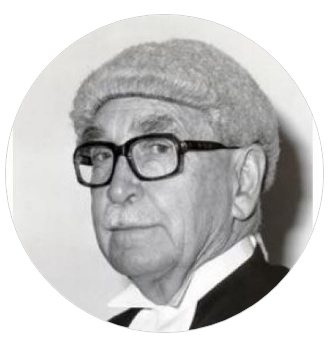
Judge Reg Carter
Judges and counsel would almost always travel by rail to circuit towns. Circuits would usually start on Tuesdays to allow for travel on Mondays.2 Judge Reg Carter told me that when he was a young prosecutor there were no such things as “two week sittings” – the court traveled to a circuit town and simply stayed there until all criminal matters had been resolved.
One of my earliest circuits was to Mount Isa. I was a judge’s clerk. It was in July, a month when diplomats based in Canberra discovered the need to travel to explore the economic potential of the north.3 A number of ambassadors were visiting the Isa, and were invited to tour underground. The Mine invited the judge (and hence me) to join in. For a young undergraduate it was a wonderful experience. At that time the Mine organised surface tours, but going underground was, for visitors, taboo.
After a few years at the Bar I was briefed regularly by a Mount Isa firm of solicitors to appear for their clients in the Supreme and District Courts in the Isa. This was, for me, an introduction to a demanding and rewarding aspect of practice at the private bar.
Over the years I appeared against, and enjoyed the company of, many barristers: Bill Carter (later Justice Carter), Richard Chesterman (later Justice Chesterman), Jim Barbeller, Richard Trotter, David Tait, Kiernan Dorney (later Judge Dorney), Richard Douglas, Michael Eliadis and several others.
A new courthouse was opened in 1972 (photograph below). Its air-conditioning seemed always to break down in mid-October, and would not be repaired until mid-February. A new Court was built in the 1990s.
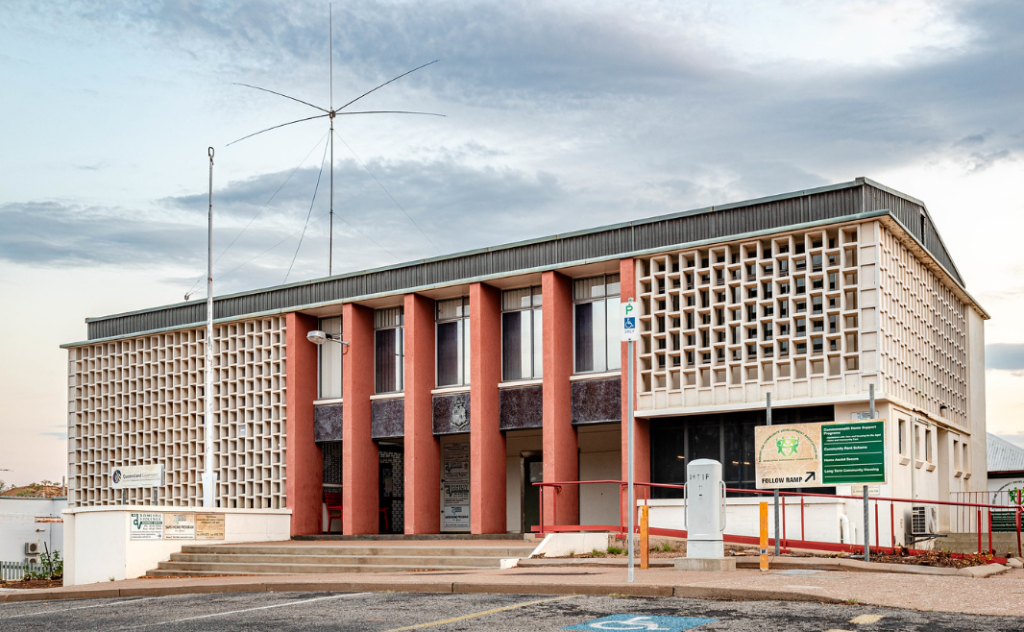
The Old Mount Isa Court House
When the Law Calendar was published each year I would cross out the Mount Isa circuits in my diary. I would usually fly to the Isa on a Sunday morning. In the days of the “two airline policy” there would be an Ansett and TAA flight out of Brisbane each morning, departing within ten to twenty minutes of each other. They would leave the Isa about 4pm, again within a short period of each other. It was a flight of about 2 to 3 hours duration, depending on weather conditions. At the time, it was in fact easier for Brisbane based counsel to serve the Mount Isa circuit than it was for those based in Townsville.
On arrival in town there would be a succession of conferences with clients for the immediate and subsequent sittings, along with – as one would undertake in home chambers – settling pleadings, particulars, answers to interrogatories, and advising on evidence, liability, and quantum. These tasks would be interrupted as trials were called on. The conferences would continue until the visiting judge left town.
There was generally a healthy collegial spirit among counsel attending those sittings. We could negotiate with one another frankly, which often lead to resolution of the case or at least significant aspects of the case. In the evenings we would often dine together, sometimes joining the judge and his associate, at the Verona Hotel – now the Ibis Verona Hotel – where we would consume some excellent wine from the owner Joe Vaiente’s vast cellar. Many stories – some true – were told on these (sometimes late) nights. Often we would all be together again in court at 9 am the next day plying our trade!4
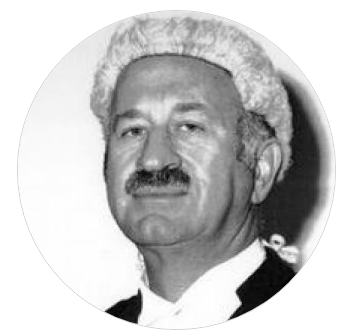
Judge Loewenthal
For counsel – and their instructing solicitors – the circuits were hard work, but usually rewarding. I remember one circuit which was called on at short notice after the regional Law Association had complained to the District Court Chairman about the lack of civil circuits. Judge Loewenthal volunteered to take an additional circuit, and he made it clear to counsel that he would keep sitting so long as we could bring matters on. He would be on the next ‘plane out, he said, once we failed to bring on a matter. I flew up on the Sunday. The judge and counsel returned to Brisbane on the 4 o’clock flight on the following Thursday. I sent out eleven fees on brief. Another counsel sent out seventeen.
After I was appointed to the Bench I could not return to the Isa for some little while as matters I had been involved in worked through the system. The first time I was able to return the heavens opened and the Leichhardt flooded. The town was “cut in half” by the river. There were enormous difficulties in ensuring witnesses were able to attend the court from the “mineside” of town let alone the outlying communities. On the weekend a local doctor I had known from student days invited me to join him and his family and friends. We travelled downstream and set up camp on the banks of the river. It was my first experience of using a swag. We cooled off by sitting on aluminium framed chairs in the river, in my case sipping champagne and smoking cigars.
At the time of my appointment the expectation was that a judge would do about four to five circuits a year, each of two weeks. Later that year the District Court’s jurisdiction in civil and criminal matters was increased significantly. Master Horton conducted several “thousand bomber raids”- as we called them – remitting many matters to the District Court. The Court’s circuit load increased significantly.
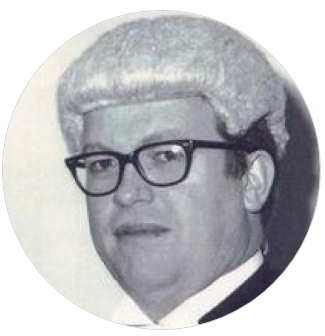
The Honourable John Westlake Barrett Helman
I persuaded the then Chairman, Judge Helman, to “give” me the Maryborough circuit, exclusively. This is not the time to argue the merits of such an arrangement. Suffice it to say that – with one or two reservations – I think it worked well. A court that had had a significant backlog in both crime and civil was “up to date” within about twelve to eighteen months. I recall one prosecutor commencing his examination of a complainant with: “Do you recall going to a party six weeks ago, ….?”
Towards the end of the circuits there would always be a dinner to which visiting counsel, local solicitors (and clerks), the magistrate, court reporters, and members of the court staff were invited. They were pleasant gatherings, and I thought they were an excellent way of cementing the relationships between all those who collaborated to make the court function for the benefit of the local community. For me one of the pleasures of working over a number of years in the one centre was seeing many young professional men and women grow in confidence and competence as they developed their forensic skills.
One of the traps of circuit work for both barristers and judges is what I think of as the “local knowledge” phenomenon. Suppose, in Mount Isa, patrons at one of the hotels, one a nipper, the other a shift boss, engaged in fisticuffs leading to charges against one of them. One could be fairly confident that most people in town would have heard of the incident, and would “know” what “really happened.” What “really happened” would differ from person to person, and in any particular case was a version influenced by whether the person’s natural sympathies were with the shift boss or the nipper.
I remember a trial at Gympie in which I appeared as defence counsel for a young man. He and his girlfriend had attended a gathering of their schoolmates at a park just out of town. There was no evidence at all that any of those attending was drinking alcohol. As they returned home the car rolled, the young woman was thrown about 50 metres from it and killed.
I recall this case particularly for two reasons.
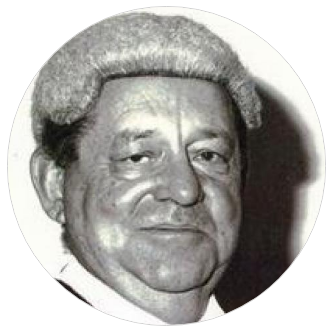
Judge Grant-Taylor
First, a few months before the trial the Police Commissioner had given a directive that, henceforth, all police officers must give evidence in the “new” metric measurements and not the “old” imperial ones. Obeying this instruction the investigating officer gave evidence that the girl’s body was found to be “.5 of a kilometre” from the car. The officer, in my judgement, was completely fair, and nothing in the case depended on how far the lass was found from the vehicle. But the more I suggested he was mistaken the more he dug in. After a while Judge Grant-Taylor adjourned the court. When we resumed after the tea break the witness said to me: “I’m sorry, Mr. Botting. I made a mistake. It was not .5 of a kilometre.It was half a kilometre.” I moved on.
Second, on the third day of the trial the Crown accepted an intimation from the judge and entered a nolle prosequi. Before going home I visited an elderly widow, the mother of a friend of mine. We had afternoon tea together, and I mentioned the case. “Ah”, she said, “that was terrible. They were all drinking, you know. They were all drunk.” I wondered how many members of the jury might have had that same “knowledge.”
As counsel I found circuits to be hard work, but financially rewarding. It was a joy to work with colleagues whom I trusted and whose competence I admired. It was fun to relax with them when we had the chance in the evenings.
As a judge, circuit work was demanding. There is, of course, a natural satisfaction in seeing cases moved through the system expeditiously – and for that to happen a judge needs the cooperation of the profession and the support of staff working in the Court system. I was very conscious of the demands made upon so many during a busy circuit. The court reporters were, at times, put under a lot of pressure. Likewise, court staff laboured to support the judge, lawyers, and litigants. I knew that counsel and their instructing solicitors or clerks were frequently working late into the night preparing their cases and seeking to resolve them.
Looking back now I realise I learnt so much from my time on circuits. I was exposed to the diverse ways of life of those who lived in such disparate centres as mining towns, rural towns, northern ports, sugar centres and provincial cities. The lifestyles and ethos of the people of such areas are in some ways so different from what I experienced in the south east of the State. In other ways there are so many similarities – just try watching a State of Origin game or the Melbourne Cup in the Isa.
Circuits gave me a heightened consciousness that the court was often perceived by the local citizens as “the government” coming to town. The quality of the newspaper reporting of our activities differed enormously from town to town, but I lived in hope that at least the jurors and others who attended the court would have a better understanding of the court functioning, not as “the government”, but as an independent branch of government working for those living in the more distant parts of our State.
- The District Court existed at the time of separation under New South Welsh legislation. For an account of the debates at the time of the 1865 legislation see Denver Beanland, A Court Apart: The District Court of Queensland (Brisbane: Supreme Court of Queensland Library, 2009), 18 ff.
- On the importance of the growth of the railways in Queensland in the 1890s, and of the reliance placed upon them by the judiciary, see Beanland, Ibid, 67. I understand that the Railway Gold Passes issued to judges until the 1990s had their origins in the 1920s need for judges to travel regularly by rail, although I have not been able to confirm this.
- In a similar vein, I recall a High Court judge observing that, of course the Court would travel to Brisbane in July, and to Hobart in February – “they’d think us mad if we did otherwise.”
- In Mount Isa in July, with the region on Brisbane time, sunrise is about 7.15 am.