FEATURE ARTICLE -
Issue 102: December 2025, Reviews and the Arts
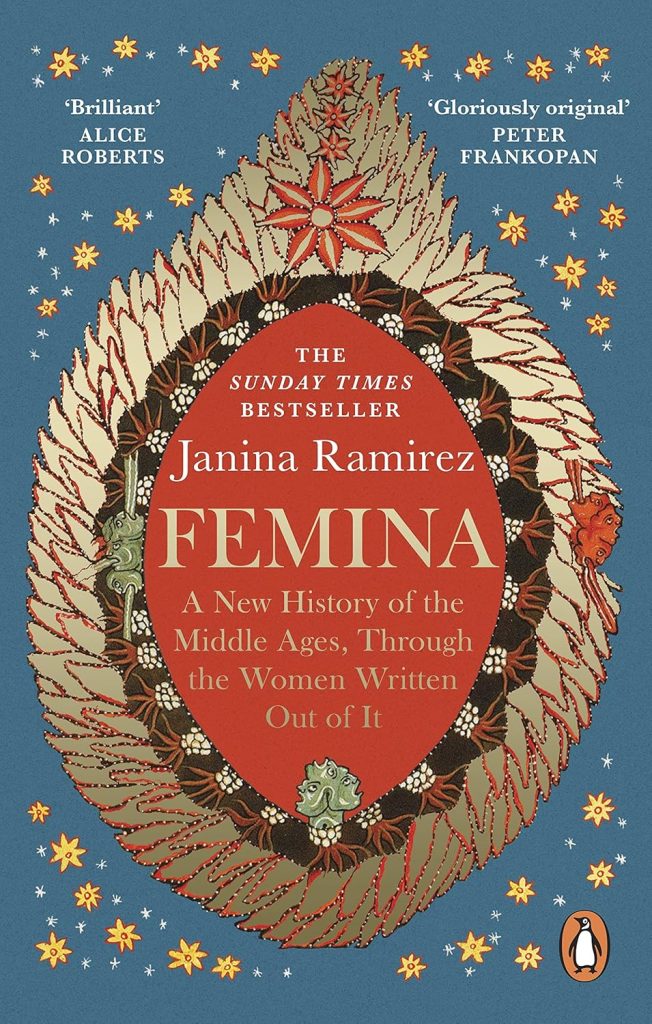
Book – ‘Femina: A New History of the Middle Ages, Through the Women Written Out of It’
Author: Janina RamirezPublisher: WH Allen (part of the Penguin Random House group of companies)Reviewer: Stephen Keim
It is not difficult to discover the author, Janina Ramirez’s central objective in researching and writing Femina. Ramirez explains her approach taken in writing Femina with clarity in her Preface which runs to less than two full typeset pages.
Ramirez explains that she is not attempting to rewrite history but, rather, is shifting the focus. Ramirez addresses specific individuals and the societies in which they lived and the shifting politics, economics, beliefs and power which operated as backdrops to those societies.
The difference between the approach of Ramirez and that of most writers who have provided us with the history with which we are familiar is that Ramirez focuses on empowered women with agency from the medieval period as a way of shifting gear and providing new narratives for modern readers.
Ramirez explains that all history writing is subjective and that, while her own approach carries its own bias, it allows scrutiny of historical evidence in more inclusive ways and permits engagement with the past through fresh eyes. It provides a way to reframe what the matters on which we place value are, going forward.
Ramirez provides a lengthier overview of Femina in her 20 page Introduction. Ramirez commences with a description of suffragette martyr, Emily Wilding Davison, who, on 4 June 1913, interrupted the running of the Epsom by running onto the track and trying to present a letter to the jockey riding the King’s horse as a result of which she suffered fatal injuries. Davison’s actions which led to her death are regarded by Ramirez as important not only because she was acting to support the campaign to achieve votes for women but, also, because Davison’s own writing had argued that women had played a much more influential role in medieval society than they were permitted in the Victorian and Edwardian societies in which she had grown up.
The balance of the introduction discusses the demeaning manner in which particularly 19th century historians had portrayed women. In discussing the lack of material available to Victorian historians to draw upon to discuss influential actions of women across the centuries, Ramirez reveals a number of interesting facts about the impact of the Reformation and, thereby, explains the relevance of the term “femina” and why it was chosen as the title of her work.
One impact of the Reformation was the closing of convents which deprived women of a way of living that allowed them to be independent and to live a scholarly life including by producing scholarly writing. The religious turmoil created by the Reformation led to the destruction of texts. Depending on who controlled the machinery of power, the books destroyed could be those expressing Catholic or Protestant ideas. However, topics identified as witchcraft or heresy constituted sufficient cause for destruction. “Femina” was a term applied to any work by a female writer and, if it were scribbled against a particular entry in a list of texts held in a particular depositary, it was likely to be sufficient to cause for the actual text so labelled to be removed from the collection and to be destroyed. Femina, as the title of the book, takes on particular poignancy once one is aware of that particular fact.
The nine substantive chapters of Femina are named for the occupational categories discussed in the respective chapters. For example, the first three chapters are, respectively, entitled: Movers and Shakers, Decision Makers and Warriors and Leaders. The methodology is obviously to showcase the important actions of women in medieval Europe across a whole range of activity.
Another characteristic of Ramirez’s method is to commence each chapter by reference to a historical “Discovery!” of some kind. These “Discoveries!” are relatively modern events with many of them occurring in the 21st Century. In each case, the discovery is sufficiently important to throw new light on what was previously known about a particular place and time in medieval history. The discussion also gives the discoverer, in each case, the well earned plaudits for the hard work in making a discovery of such importance.
By using the discovery as the starting point of the discussion in that chapter, Ramirez is able to direct the attention of the reader to a particular geographical area at a particular chronological period. Each chapter discusses a period of time later than that discussed in the preceding chapter. By the end, Ramirez has, effectively, achieved a representative sample of the way in which societies operated in different places and at different points of what is generally described as the medieval period.
Since the key individuals discussed in each of the chapters are women, Femina also manages to cast quite a different light on medieval history as a whole and goes a long way to rectify the limitations of previous mainstream history which, as the Introduction makes clear, has almost entirely written women out of the historical record.
Chapter 1, Movers and Shakers, starts with a discussion of its keynote discovery, made by archaeological detective, Steve Sherlock, in 2006 at a well-worked site near the town of Loftus in the North Yorkshire Moors. The discovery, in what was known as grave 42, was of evidence of the form of burial of the woman who has become known as the Loftus Princess. The evidence consisting of metal and precious stones has allowed Ramirez to paint a picture of the life led by the Loftus Princess and the community in which she lived. The Princess was buried in a bed (a sign of the high esteem in which she was held by her community) and was wearing very precious jewellery also indicating the influence she wielded during her life during the Seventh Century CE.
Ramirez, armed with the in situ evidence then draws upon what is known about other jewellery of the kind found in grave 42 to infer more about the Princess’s likely influence in her community during her life. Ramirez also draws upon contemporary writings such as the epic poem, Beowulf, and the writings of the churchman, the Venerable Bede, to throw more light on the type of influential person the Loftus Princess was likely to have been.
In a method followed in subsequent chapters, Ramirez focuses outwards from the central character to chart the broader society of that time and the role played by women in that broader society and, drawing from that information, focuses inwards again upon the life and times of the central character, the subject of the important discovery for that chapter. This is an iterative process drawing upon vast quantities of specialised knowledge and, with each iteration, the reader’s understanding of the broader and more narrow societal contexts becomes deeper and richer.
Ramirez deploys her writing skills and extraordinary research skills to produce a fascinating introduction to quite esoteric historical subjects. The reader, even if not wiser for the experience, is much better informed for the effort.
Chapter 2, Decision Makers, begins with a discovery in August 2021 at Cookham in Berkshire, England, of evidence of the presence of the monastery over which the abbess, Cynethryth, presided during her life in the 8th Century CE. The broader discussion is of various powerful women of that time exercising power and influence in the Anglo-Saxon Kingdom of Wessex.
Chapter 5, Polymaths and Scientists, begins with the actions in 1948 of medieval scholar, Margarete Kuhn, in post-war Germany to secure the safety of an original vellum manuscript of 12th Century theologian, scholar and musician, Hildegard of Bingen. Hildegard will be known to some readers of Femina if only because her musical compositions continue to be played and recorded and shared in the 21st Century. Nonetheless, Ramirez’s detailed presentation of Hildegard’s broad range of creative and scholarly achievements is enjoyable to read and pleasantly instructive.
Femina constitutes a conception of originality, beautifully executed. It succeeds in demonstrating that much historical writing leaves out more than it conveys. The great man conception of history leaves out the history of half of everybody who lived and very much more. Femina demonstrates, without being preachy at any point, that there are better and more inclusive ways of describing the past.
A deeper truth emerges from Femina. Ramirez’s references to the writings and beliefs of Emily Wilding Davison emphathise this truth. If we believe, wrongly, that women (or any minority group) failed to contribute to learning and the well-being of their societies, we are more likely to believe that any future such contribution may, also, be disregarded and obstructed. A richer and more inclusive understanding of the past can only enhance a rich and more inclusive future.