FEATURE ARTICLE -
Issue 102: December 2025, Reviews and the Arts
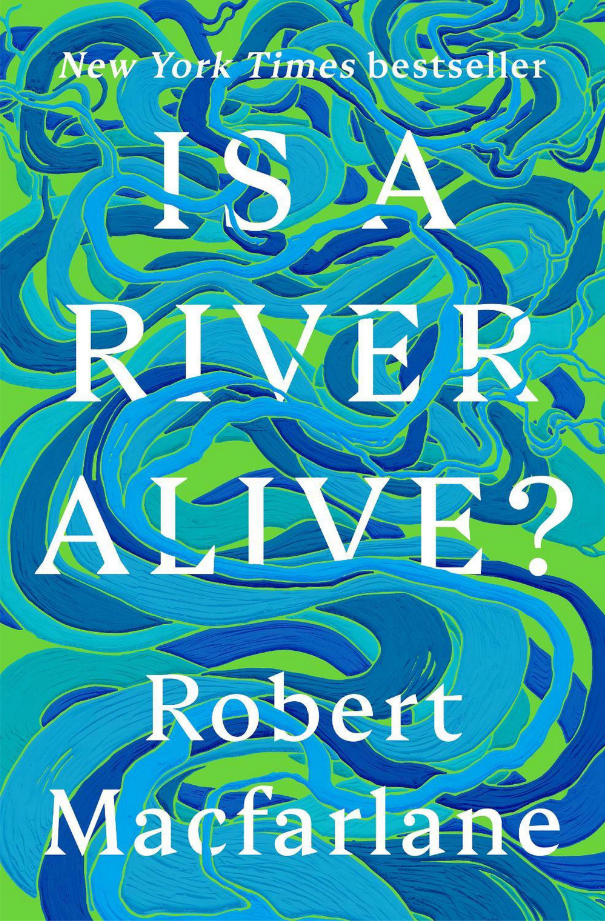
Author: Robert MacFarlanePublisher: Hamish Hamilton (an imprint of Penguin Books)Reviewer: Stephen Keim
It is nicely ironic that, about a year after reading and reviewing my friend and former chamber mate, Simon Cleary’s first foray into non-fiction books, Everything is Water, I should embark upon Robert MacFarlane’s Is a River Alive? Simon’s work is his account of and reflections upon his journey traversing (mainly walking) the Brisbane River which has played such a significant role in his own life. Everything is Water, although framed as a positive statement originally articulated by Greek philosopher, Heraclitus, is a title seeking to indicate that Simon was asking the big questions not just going for a long walk.
I am fated to read about rivers. Langston Hughes’ The Negro Speaks of Rivers is one of my favourite poems.
MacFarlane’s Is a River Alive? is a story of three journeys involving rivers. As his title might suggest, MacFarlane, also, is not averse to big questions. Each such journey is the focus of one of the three parts of Is a River Alive?
MacFarlane was born on 15 August 1976. He is within 12 months of his fiftieth birthday. He is the author of ten non-fiction books. From their titles alone, one may infer with some degree of comfort that many of these books required much physical exercise in the acquisition of the experiences on which they were based. The three journeys described in Is a River Alive? are no different and one can empathise with the occasional aside by Macfarlane in the text that his body’s resilience is being tested by the task he has asked it to perform.
The structure of Is a River Alive? is very simple. MacFarlane has chosen three different parts of the world in which rivers are being stressed and threatened. He undertakes a journey in order to experience the waterway’s qualities and to understand those who would destroys those qualities and, in large part, the river, itself.
Most importantly, MacFarlane does not take these journeys, alone. In the case of each of the threatened environments, he has located and become friends with people who belong thereto and who are working to protect it. The journey, in each case, is made with these colleagues and it is the interactions with them and the wisdom and learnings that they bring which are as important as MacFarlane’s own reflections and the contributions of the rivers, themselves, to the narrative.
Part 1 of Is a River Alive? document’s MacFarlane’s journey to the Los Cedros Cloud Forest in Ecuador which hosts the upper reaches of the River of the Cedars. The cloud forest and the river are threatened by the predations of mining companies but, in contrast to other majestic environments in Ecuador, for the moment are protected.
Part II documents a trip to Chennai and its environs in Tamil Nadu state in India. This is the story of three rivers which flow through Chennai which are, in many parts of their respective courses dead and devoid of life. This narrative is one that finds life and beauty amongst destruction and a story of activists prepared to fight rearguard actions to protect what remains and to roll back the destruction which has occurred.
Part III occurs in northern Quebec. It is the story of the Mutehekau Shipu River and those who are fighting to protect it from Hydro-Quebec, a state hydroelectricity company whose insatiable desire to build dams and, thereby, turn living rivers into dead lakes rivals the madness of Tasmania’s dam builders who drowned Lake Pedder and tried to destroy the Gordon below Franklin.
MacFarlane lives in Cambridge in England. As a prologue to the three stories of grand rivers, he provides an archeologically informed short prehistory and history of the chalk springs within walking distance of his home and the little creek to which they give birth. A little update on the life of the springs during the time it took to take each journey provides interludes and then an epilogue to the main narratives.
MacFarlane’s narrative, obviously, benefits from the landscapes through which he travels. The parts of the narrative are kept together by the themes of river ecosystems under attack and in danger of destruction by different aspects of humankind’s desire to subdue the earth; the rights of nature as a jurisprudential concept; and, of course, the overwhelming question which provides the title of the book.
The narrative, however, gains depth and richness from the expertise and personality of MacFarlane’s companions on his journeys. In the Los Cedros cloud forest, MacFarlane spends time with Giuliana Furci,[1] a very famous expert on fungi, two activist lawyers, Cesar Ridriguez-Garavito and Cosmo Sheldrake; two Ecuadorian Constitutional Court judges, Ramiro Avila-Santamaria and Agustin Grijalva Jimenez, both of whom sat on the case which upheld the rights of Los Cedros to be protected from destructive mining; and an idiosyncratic self-appointed forest defender, Josef DeCoux.[2] The companions and their interactions with MacFarlane and their experience, learning and expertise bring colour, movement and a sense of understanding and social context to MacFarlane’s account of his experience within the cloud forest and the complex ecosystems of which it is comprised.
Since the events described in Is a River Alive?, the Trump allied Ecuadorian government sponsored a referendum to remove the rights of nature provision on which the Los Cedros decision was based but the proposal was, overwhelmingly, rejected by the Ecuadorian electorate.
MacFarlane explores the Chennai river systems with Yuvan Aves, a twenty-seven year old teacher and activist. Aves spent much of his first 14 years being beaten badly by his stepfather. Finally, he decided to run away – to his school – which sent him to a residential school, fifty miles away, called Pathashalla KFI, and it was there that he put his life back together and further developed his incredible skills to observe, understand and teach nature. Living with Aves may be something of a challenge since his love of and devotion to invertebrates, along with other cuddlier forms of life mean that wasps can conduct their lives alongside those of the humans living in the house without fear of disturbance.
The three main rivers, Adyar, Cooum and Kosasthalaiyar, are considered devoid of life where they pass through Chennai although heir upper reaches still support many species of birds and other forms of life. The lower reaches are not only practically unable to support life, they are positively dangerous to humans through the poisonous pollutions they have acquired from years of industrial operations.
In this context, no fight is too big or too small for Aves’ and his students and allies. He guides MacFarlane through a scrappy piece of restored woodland pointing out the plants and pollinators who have established themselves in this tiny refuge.
MacFarlane is told a story of the ruthlessness of those who support more industry at the cost of humans and every other species. The story comes with a map. In the nineties, in the wake of the Rio Earth Summit and Agenda 21, the Indian government directed state and regional governments to prepare plans to protect the environmental qualities of waterways within their jurisdictions. A beautiful backwater of the Kosasthalaiyar River, Ennore Creek, was favoured by industrialists and their politician mouthpieces for more polluting development. In order to prevent their plans from being curtailed by environmental planning processes, the local authorities produced a map of Ennore Creek which disappeared the water body. For years after, local residents sent the federal environmental bureaucrats pictures of themselves, neck deep in water, with the message that the map was wrong and a waterbody requiring planning existed in accord with federal laws even as new factories were approved, built and operated.
It is this destructive heritage that Aves and his helpers fight to unravel and unwind, protest by protest, court case by court case. And, against all odds, they win small victories, one after another. Whereas the Los Cedros is a battle to protect a priceless environmental area from the forces that would destroy it, the Chennai story is one of winning back environments that have already been destroyed and stolen. It is a story of hope and resilience.
For his visit to the Mutehekau Shipu River, MacFarlane commences a car journey along the Gulf of St Lawrence with Wayne Chambliss, a polymath whose special talent is understanding and experiencing geophysical processes.
Their road journey ends at Ekuanitshit, a small Innu community near the mouth of the Mutehekau Shipu. This is where MacFarlane meets Innu poet and activist, Rita Mestokosho. Rita is not coming on the next part of the journey but she gives both Chambliss and MacFarlane instructions and directions on the spiritual aspects of their time on the river.
Going to store his possessions unwanted during the next part of the journey, MacFarlane recruits a fisherman and kayak adventurer, Ilya Klvana, to the journey. The final two members of the group, Raph St-Onge and Danny Peled, are to provide the practical expertise that is particularly needed to get MacFarlane and Chambliss safely through the dangers that await them.
The first part of MacFarlane’s third river experience involves many hours of flying north in an old, float plane, a De Havilland Otter, to the northern shore of Lac Magpie, a long lake that interrupts the Mutehekau Shipu’s rapid journey to its mouth in the Gulf of St Lawrence. The main adventure involved a number of day’s paddling the windy lake followed by more than a week descending the rapids any one of which could result in death or injury. It is one hell of a way to find connection with even a glorious river. It is comforting to the reader to know that MacFarlane must have survived because he is telling the story.
Is a River Alive? is a crusading book and its author seeks to explore and promote different ways in which the rights of nature can help prevent the glories that have not yet been destroyed by obsessive humans.
While the message is clear, the tone never approaches any kind of hectoring. MacFarlane allows the landscapes to do their own talking. MacFarlane’s own explorations of character and context maintain the reader’s interest level so high that the reader never feels yelled at. The personalities and sheer pedagogic knowledge of MacFarlane’s various companions also add to the interest level.
Is a River Alive? is a great book about the importance of conserving nature. But it is also an example of an excellent travel book, a genre in which I have maintained a long interest.
[1] MacFarlane is a very impressive observer of birds wherever he travels. Furci is a mycologist. There is banter between the two of them about whether looking up or looking down is the best way to understand the world.
[2] DeCoux died in May 2024: https://www.rainforestconcern.org/news/hero-of-the-ecuadorian-rainforest.