FEATURE ARTICLE -
Issue 102: December 2025, Reviews and the Arts
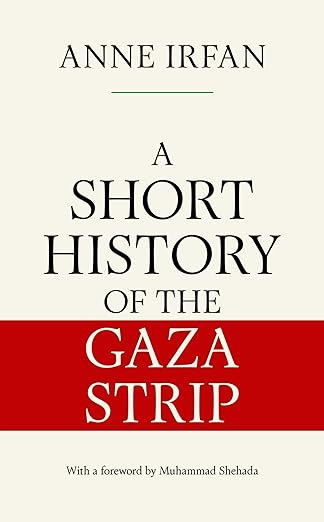
Author: Anne IrfanPublisher: Simon & SchusterReviewed: Stephen Keim
Considering Gaza’s long connections with many empires going back to that of Ancient Egypt, at slightly over 200 pages, A Short History of the Gaza Strip (“Short History”) is, indeed, short.
Perhaps, for reasons of acute current relevance and reader’s accessibility, apart from a few pages of introduction, Dr Irfan has limited the scope of Short History to the period commencing with the Catastrophe or Nakba in 1948 and finishing, by way of an Epilogue, with the bombing and invasion of Gaza that followed the Attacks of 7 October 2023.
Indeed, that title of the last chapter seems to emphasise that one of the purposes of Short History is to assist lay readers to place the events of 7 October and the events that have followed in a historical context.
In another sense, the Gaza Strip, itself, does only date from 1948, as Irfan explains. In 1948, when the State of Israel was established by force over 78 per cent of what had been Mandatory Palestine, it also claimed the majority of what had been known as the district of Gaza leaving just 141 square miles as the newly formed Gaza Strip. Socially and demographically, the Gaza Strip was also created by Israeli force as the majority of Palestinians in the Strip comprised refugees who were expelled or displaced from other parts of what had been Mandatory Palestine.
While every square millimetre of the Gaza Strip does have a thousand year history, the Gaza Strip, itself, is a product of the catastrophic events of 1948.
Irfan is very well qualified to write the Short History. She is a Lecturer in Interdisciplinary Race, Gender and Postcolonial Studies at University College, London. Irfan has previously lectured in Forced Migration at the University of Oxford’s Refugee Studies Centre. In 2023, she published Refuge and Resistance: Palestinians and the International Refugee System in 2023. She has won a number of prizes for her peer reviewed publications including the Alixa Naff prize in Migration Studies for her article Educating Palestinian Refugees: The Origins of UNRWA’s unique schooling system.
The Short History and the Strip start with the Nakba or Catastrophe. The 1947 plan to partition Palestine is noted by Irfan as the immediate trigger for Palestine’s descent into disorder. Israeli historian, Benny Morris, is quoted by Irfan as pointing out that ethnic cleansing of Arab Palestinians was a core and necessary part of Zionist ideology. Zionism required a land which was Arab to be turned into a Jewish state and a Jewish state could not arise without a major displacement of the Arab population. In November 1947, alone, Zionist militias forced 75,000 Palestinians into exile. The method included massacres in village after village. Villages like Deir Yassin (where up to 250 out of a population of 600 people, men, women, children and babies, were massacred) remain burned into the memory of all who experienced these events. The plan worked. By the end of 1948, 750,000 Palestinians, around two thirds of the population had been forced to flee their homes and become refugees.
The impact on Gaza was profound. Gaza City as one of the few Arab strongholds in Palestine was an obvious destination for those displaced and seeking safety. In April and May 1948, the city received 10,000 refugees from Jaffa, alone.
Before the Catastrophe, there were the Ottomans who ruled Palestine and much of the Arab world. Palestine, though, contained Muslims, Christians and communities of Jewish people. In 1917, there was the Balfour Declaration in which Britain promised national rights to Jewish people, most of whom lived otherwise than in Palestine, and ignored any national aspirations of the Palestinians who resided in that land. The League of Nations Mandate for Palestine reinforced the Balfour Declaration and authorised Britain as the occupying power to foster a proto-Zionist governing body (and Zionist military forces) via the Jewish Agency.
In 1936, there was an Arab rebellion which started with a six month general strike. The rebellion, though it lasted three years, was crushed with brutal military force by the British.
Short History’s chapters follow the chronology: the Egyptian era; Israeli occupation (starting full-time in 1967); the First Intifada (from 1987); the Oslo Years (commencing in the early 90s) which led to increasing hardship and, in turn, to the Second Intifada; the rise of Hamas (which was both a development encouraged by the State of Israel as a foil to Fatah and the Palestinian Authority and used as a reason to suppress even further the aspirations of Palestinian people for self-determination); and, finally, the Epilogue (commencing on 7 October 2023).
A few short observations may be seen as emerging from Irfan’s absorbing history.
Both the Arab rebellion and the First Intifada are examples of a theme in the history of Palestinian resistance, namely, that rank and file Palestinians tend to get frustrated with the ineffectiveness of their leaders and bring their own energy and creativity to find their own new ways of resistance.
Palestinian resistance to Israeli (and, previously, British) occupation is often peaceful or involves low levels of violence (throwing stones at military vehicles) and is met by high levels of violence such as deliberate breaking of bones or lethal force.
The Oslo Accords were broadly welcomed, including by rank and file Palestinians, but, ultimately, were a disaster for most Palestinians including those living in the Strip. While the bureaucrats of the Palestinian Authority got to return to live in Ramallah and live a relatively privileged life, the occupation became more restrictive and more difficult for other Palestinians. The increasing oppression that resulted led to the Second Intifada.
The Second Intifada became a true horror with both Hamas and Fatah organising suicide bombings which targeted and killed some Israeli citizens with brutal responses by the Israeli government. However, it started with the same kind of stone throwing and civil unrest that characterised the First Intifada. The immediate Israeli response to such protests was a characteristic disproportionate use of lethal force. 1.3 million bullets were fired in the occupied Palestinian territories in the first few days.
Irfan’s Short History is closely referenced and she draws on Israeli (such as Benny Morris, quoted above, and Ilan Pappe) historians. Irfan also draws on personal memoirs of Palestinians who have lived through much of the period covered by her narrative. The Short History is able to illustrate historical events (such as the Deir Yassin massacre) and periods such as the post 1967 Israeli occupation of Gaza by recounting the personal experiences of a particular family or individual.
I was reminded of Robert Hughes’ The Fatal Shore, a history of the convict system in the early parts of Australia’s colonisation. Convicts who experienced the torturous conditions of Norfolk Island would turn up experiencing even worse conditions at Macquarie Harbour or Port Arthur. The experiences of individuals gave human faces to the horrific system being described.
In Short History, a young boy or girl forced to flee with their family from Jaffa in 1948 turns up in later chapters as a leader of civil society or someone forced to flee to Egypt to avoid Israel detention. This drawing from memoirs has the same effect as in Robet Hughes’ classic of personalising the events and giving them a vivid reality that mere statistics of dead and wounded cannot achieve. The effect is also to give the reader an understanding of Gazan and Palestinian resistance by providing an understanding that hardship or oppression experienced at one stage of a person’s life will motivate a person to fight that oppression as an adult.
This recounting of personal experiences is also seen in the foreword to Short History written by Muhammad Shehada who grew up in Gaza and who is now a distinguished journalist, researcher and commentator, still reporting from Gaza. As well as setting out his own experiences, Shehada narrates the experiences of a childhood friend, Ali who remained in Gaza and was killed by Israel in January 2024 at the gate of al-Asqa hospital in Deir al-Balah. Ali also contributed to magazines as a journalist, reporting from within Gaza.[1] Shehada sums up the experiences of the residents of Gaza in the nearly 80 years since the Nakba by saying of his friend: “The toughest thing about his death is that, like most young Gazans, Ali never got the opportunity to experience living, despite how he tried every single day.”
Of course, the whole of the Short History provides the reader with perspective on the events of 7 October 2023. Irfan quotes Amira Hass, a daughter of Holocaust survivors and a veteran Israeli journalist who states that atrocities were committed on 7 October but who goes on to say that this “… tells me how the pressure has built up, how monstrous it was, to create those monstrous attacks in one day”.
The Epilogue publishes the results of the very detailed journalistic research which has been carried out as to the events of that day. It seems that very few journalists and very few media outlets have been interested in informing their readers about what that research reveals about the events of the day. Irfan cites international analysts; the International Criminal Court; and even the Israeli military, itself. The attack occurred in a series of waves. The Nukhba forces breached the Gaza barrier and began targeting military sites as well as attacking some civilians. Once news spread that the fence was open, further waves of armed people crossed the border. These included other Hamas non-Nukhba units; six other armed factions; criminal gangs and non-affiliated militants. The later waves were more chaotic and disorderly and carried out much of the widespread killing of civilians across southern Israel. This timeline suggests that the admitted slow response by the Israeli military to the breaching of the security fences at the border made the death toll, that day, much worse.
Surprisingly, Irfan does not discuss the Israeli military’s failure to respond in any detail. She also does not discuss the extent to which Israel’s activation of its Hannibal Directive contributed to the civilian deaths, that day.
Irfan does document the ferocity of the Israeli continuing attacks on Gaza, killing tens of thousands of civilians, and amounting in the eyes of international and Israeli human rights organisations; the International Court of Justice; and Jewish observers including some holocaust survivors as amounting to a genocide.
For over two years, our consciences have been shocked by events occurring in an area bordering the southern Mediterranean. Not surprisingly, many of us have known little of the historical context in which these events have been happening. It is fair to say that neither our political leaders nor what has become to be called our legacy media have been at pains to provide us with any kind of deeper and nuanced understanding that we feel we need.
Dr Irfan’s Short History comes at an important time. It is the primer many of us have been, perhaps, unconsciously searching for. Short History comes highly recommended by this reviewer.
[1] Articles by Ali Adam can be accessed online at Middle East Eye, Al Jazeera and Al Monitor.