FEATURE ARTICLE -
Issue 102: December 2025, Reviews and the Arts
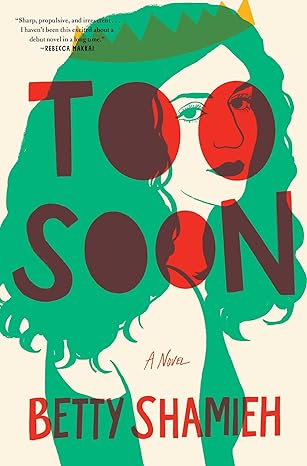
Author: Betty ShamiehPublisher: Avid Reader Press (an imprint of Simon & Schuster, LLC)Reviewer: Stephen Keim
Too Soon is a novel which tells the story of three women, members of one of the founding Arab Christian families of Ramallah, the administrative centre of the West Bank Occupied Territory of Palestine.
Each woman relates her story in the first person.
Arabella is a Palestinian American theatre director whose career which began, very promisingly, has, perhaps, stalled in recent times. Arabella relates events occurring in her life in 2012.
Zoya is Arabella’s grandmother and Arabella is the grandchild who has always been closest to Zoya. We know from Arabella’s narrative that Zoya is now (in 2012) living in America. But Zoya’s narrative begins in 1948 and takes the reader to Jaffa where Zoya is living with her husband and seven daughters. The family is wealthy and has moved earlier from Ramallah to Jaffa, the port city of Tel Aviv.
Naya, whose narrations are delayed until the last third of Too Soon, is Zoya’s seventh daughter and Arabella’s mother.
In the early parts of the book, the narration switches between Arabella’s story and Zoya’s story although the reader has some idea of Zoya as a grandmother in 2012 from the interactions described in Arabella’s narrative. This switching is an effective device at maintaining reader tension in that, on each occasion, the chapter seems to end at a point where the reader is desperate to know what happens next. That excitement must be shelved and the reader must calm down and try to recall the point to which the other narrative had reached and immerse herself, once more, therein.
Zoya’s story presents the shock of the Nakba as it was experienced even by wealthy Palestinians and how their lives were disrupted. Zoya’s family lose everything; flee back to Ramallah for their safety; and are forced to share a one room house belonging to Zoya’s father. Eventually, the family go to America with Zoya’s husband attempting to rebuild their life by working in the Ford Motor Company’s manufacturing plant in Detroit.
Meanwhile, Arabella’s 2012 narrative has her, in many ways, reluctantly, taking an opportunity to direct a British financed presentation of Hamlet scheduled to commence in Ramallah and tour the Occupied Territories. Part of what convinces Arabella to take the opportunity is that Zoya has conspired with another grandmother to have a Palestinian American doctor (also with Ramallah ancestral connections) telephone her. The telephone conversations have gone well and a meeting in person in Jerusalem looks quite attractive to Arabella whose adventures in love to this point in time have proved inconclusive at best.
Naya was married off at a young age and strongly against her wishes by her parents with Zoya taking an active and insensitive part in achieving that object. Her marriage took her to the Bay Area of California and her husband proved to be kind and smart and proved the latter by making lots of money. Nonetheless, like Zoya before her, Naya has always regretted that her education was cut short by marriage and childbirth. Her self-confidence suffered and she struggled to find friends and equanimity in her new life as a wife and mother. The relationship between Naya and Arabella has always proved testy.
Betty Shamieh has written 15 plays and Too Soon is her first novel. Shamieh became the first Palestinian-American to have a play premiere off-Broadway with the 2004 premiere of Roar, a drama about a Palestinian family. Shamieh would have had to do no more than draw on her own experiences and observations to fill in the details of Arabella’s fictional life as a New York theatre director.
Each of the central characters, Arabella, Zoya and Naya, has marked personality flaws and is capable of insensitivity, selfishness and a degree of cruelty. The reader is likely to attribute a degree of this conduct to generational trauma and each of the three has suffered, in different ways, trauma of this kind.
It is also the case that each of three characters are far from blushing violets when it comes to matters of sex and sensuality. This might be thought to be unexpected of three women, albeit, that they are from separate generations, who were raised in a very traditional culture and instructed that, as women, they should distrust all men and that a women’s role, from a young age, was no more than to serve and deliver children to her husband.
The use of the first person narrative is effective in allowing each character’s foibles to be revealed by the person relating themselves displaying such foibles. They acknowledge their wrongdoing but cannot help themselves. The result is that, no matter how unsatisfactory the conduct might be, the reader, hearing it from the person responsible therefor, is understanding of the context in which it happens.
Too Soon is obviously intended to present a Palestinian American view of life and the world. Although published in 2025, by being set broadly in 2012, the novel avoids commenting directly on the events of 7 October 2023 and the over two years of destruction of Gaza and killing of Gazans that has occurred since then.
Shamieh approaches the task of communicating a worldview in the style of Vercors’ brilliant World War II novel, La Silence de la Mer. Vercors uses a good Nazi who is kind but believes in the goodness of his nation’s intentions. Slowly, facts cause his favourable views to unravel. The propaganda value of the novel was much greater than if Vercors had portrayed all Nazis as bad people.
In a broadly similar way, Shamieh depicts Arabella as interested only in her own personal life and unenthusiastic about the politics and injustices of her family’s homeland’s occupation. In Occupied Palestine, however, Arabella’s love interest, Azziz, who is volunteering as a doctor in Gaza, has bullet wounds through both legs acquired when attending a demonstration. Azziz also relates his massive sadness and anger at the deliberate actions by the IDF in shotting talented young Palestinian footballers in the legs to wreck their chances of a football career. And through the experiences of Arabella and Azziz, the reader obtains a consciousness of Ramallah as, on the one hand, a thriving metropolis but, on the other, a city under siege which can only be entered or departed from through uncertain checkpoints staffed by soldiers with high-powered weapons always at the ready.
The most moving depiction of life under Israeli occupation is through Arabella’s interactions with a group of young women all of whom have spent some time detained in Israeli prisons and who have to debate whether or not it would only make their lives worse to complain about being sexually assaulted at checkpoints by a male Israeli conscript.
But Too Soon is far from a propaganda piece directed at Israel. Arabella is markedly affected by hearing the story of a mother of a Jewish theatre colleague and friend who, with her family of Egyptian Jews, was forced to depart from Egypt by the government of that country.
And Too Soon is also about how traditional patriarchal Palestinian culture, with its early arranged marriages and its devaluing of the lives of women as people, prevents them from pursing their aspirations for education and a valued existence outside the home. Too Soon carries the warning that all cultures must look inward and be prepared to criticise those customs which, despite an honoured history, do harm to people within that culture.
Finally, Too Soon is a novel about life and loving and finding one’s way. It is about how our respective families prepare us for the outside world but, at the same time, place us at a disadvantage. Too Soon is very much about lost loves and lost love. It is about making good decisions but, also, about making things work, no matter what.
I found myself turning pages to find out what was going to happen next. But I have, since I finished reading, also found myself thinking about the issues raised by Too Soon and what they mean for other lives.