FEATURE ARTICLE -
Issue 101: September 2025, Reviews and the Arts
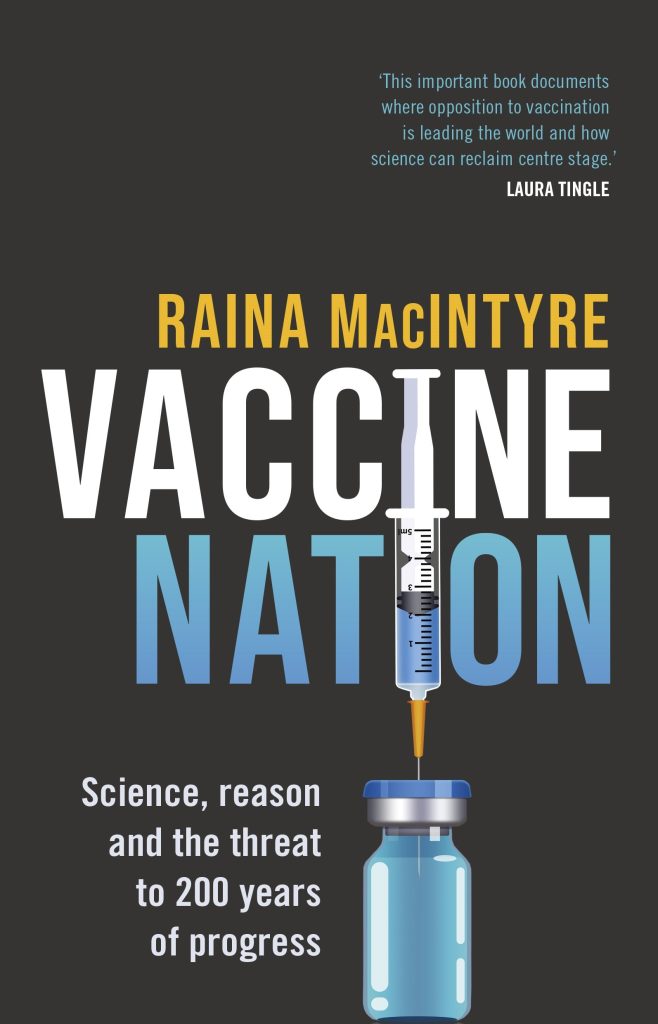
Author: Professor Raina MacIntyrePublisher: NewSouth PublishingReviewer: Brian Morgan
At the outset, let me say that this Vaccine Nation is a great book, written by a highly skilled doctor and academic who has what some people call, “the gift”, meaning the ability of writing in a way which is understandable to people from other vocations.
Anyone thinking of “vaccine” might be forgiven for immediately jumping to COVID but don’t forget measles, polio, smallpox, Ebola, monkey pox and tuberculosis which are but some examples of contagious diseases that require a vaccine to control or, hopefully, eliminate them. The author informs us of these as well as many other diseases that are perhaps not as well known.
Let me digress for a moment, to focus on the author. As a barrister, one sometimes finds oneself needing an expert in a field, let’s say physics. The expert may have eminent qualifications and be widely published. But does that person have the skills to translate their understanding into one which a Court or jury can also understand? Frequently, in my experience, they don’t.
This author does.
Her prose is eminently understandable. Where she uses words with which we are likely to be unfamiliar, she immediately explains them in simple terms. She does not talk just in academic words but her style of writing is such that this work was readily understandable to me and, therefore, I am sure, to other lawyers.
MacIntyre does not confine her discussion to Australia but focuses on disease outbreaks throughout the world in economically advanced countries like the United States and, on the other side of that coin, in developing countries, as well.
A little of MacIntyre’s own life’s experiences are injected (pun intended), to make a point, such as the way she has been disrespected because she was not born in Australia and her reaction when her infant son contracted a disease and she, as a mother, seems to have partly blamed herself for not having had him vaccinated. Wouldn’t we all apply the “What if” concept if it were one of our children? MacIntyre also refers to some of her own experiences together with those of adult members of her family, in a way which demonstrates that her worldview extends to real life as well as to her academic training.
MacIntyre reminds us that, in the early days of COVID, Dolly Parton gave funding towards the development of a Moderna vaccine and even adapted her well known song “Jolene” to “Vaccine” which was sung as she received her vaccine.
I received AstraZeneca as my first vaccine against Covid. Since then, I have received annual injections of Moderna. Do we know the difference between them and why the former is no longer approved in Australia? Read this book and you will quickly find out.
Do we have any idea of how much continuing research goes into even the influenza vaccine which we are encouraged to have each year?
These are just two examples of issues which the author explains plainly and simply so as to improve our understanding that a vaccine is not developed overnight; it is subjected to rigorous testing which does not cease when it is sent to the market; and how, with viruses which mutate, such as Covid and influenza, the fight to keep ahead of the latest variants of the disease, continues.
Just in case you are wondering whether to continue with Covid boosters, perhaps, the following observation might help your decision making.
MacIntyre points out that a recent study found that 5.4 percent of people in Australia are living with Covid. She goes on to point out that employers may start caring when the productivity of their employees drops due to workers being affected by Covid but regrets that so much denial and silence remains towards both the short and long term consequences of Covid. (I deliberately paraphrase her comments as my review copy of the book is a pre publication version and therefore I prefer not to appear to be quoting directly from it.)
Earlier, MacIntyre spends most of a Chapter pointing out the risks and consequences which may arise from contracting Covid. These include the misdiagnosing of conditions and, as a result, mistreating them, heart attacks and strokes. But do we ever hear of these?
And what of the anti-vaxxers? A lawyer could say, after reading this book, that, in her own quiet way, MacIntyre has systematically and clinically dissected their largely irrational rants but as I, myself, have seen, many times, when trying to dissuade an antivaxxer from a particular point of view, you would have more luck talking to a brick wall. MacIntyre, I think, seems to have had the same result where she has taken the time over the years to try to engage with such people; point out their errors with logic, demonstrated data and calmness; and got nowhere.
Whilst Vaccine Nation is not written for lawyers or by a lawyer, it is one which will readily fill in many gaps in our knowledge and understanding of diseases, disease control, topics such as “herd immunity” and vaccines. Vaccine Nation is a model for ease of understanding by people who do not have the professional training of the author. I intend to purchase a copy for my daughter and for each of my sons and their doctor spouses.