FEATURE ARTICLE -
Issue 102: December 2025, Reviews and the Arts
Author: Barbara Minchinton with Philip BentleyPublisher: La Trobe University PressReviewer: Bianca Stringer
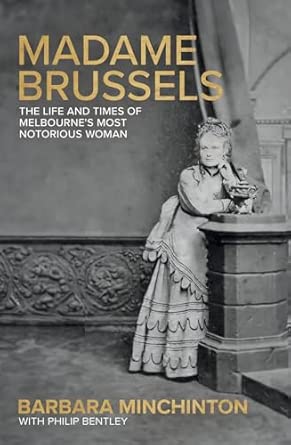
Madame Brussels (also known as Caroline Hodgson) was given many labels during her lifetime, often by the news outlets of the day.
She was described as ‘the worst and wickedest woman in Melbourne’ and a ‘feculent fiend in female form’. Whilst these might be synonymous with being “notorious” and ‘Melbourne’s most infamous flash madam’, it is evident to this author, at least, that Madame Brussels was, purely and simply, an entrepreneurial businesswoman who saw and made the most of opportunities that were available to her and had the ability ‘to earn a lot of money very quickly’.
This thoroughly researched book by Barbara Minchinton with Philip Bentley, seamlessly, blends together the biography of Madame Brussels with the social history and development of Melbourne in the late 1800’s: a vibrant, cosmopolitan and fast-changing city, overflowing with ambition and wealth – the “halcyon days”.
An interesting read for anyone, this book traces Madame Brussels’ formative years, including her childhood in Prussia and her early life in Europe before her eventual migration to Melbourne, Australia in 1871.
The book delves deeper than just Madame Brussels’ business operations and gives the reader a perspective on her life, more generally. Two husbands, both who frequently left Madame Brussels to her own devices, adopting an abandoned child, much scandal, along with several run-ins with the law: Madame Brussels certainly led an interesting and rich life.
Most important is how Madame Brussels came to own and run several “boarding houses” (brothels) on Londsdale Street. The properties that she purchased were done so in her own name; a reflection of the Victorian law whereby women, who married after 1 January 1871, had the right to hold property in their own name – though her then husband could have challenged that ownership at any time.
Lonsdale Street was once the heart of Melbourne’s red-light district in which there were many brothels and other illicit activities[1] and Madame Brussels established a luxurious and exclusive venue catering to those in the elite social and political circles in Melbourne. It was a smart decision really given that Lonsdale Street also had a strong connection to the law. Madame Brussels’ properties were located very close to the Parliament of Victoria which provided her with many influential clientele and introductions to ‘high connections’. The Supreme Court of Victoria and Country Court were also nearby having been built on the south-east corners of William and Londsdale Streets in 1884.[2]
The connection between the law and the location of her brothels is quite fitting given the legal issues that would befall Madame Brussels over the years. Running a brothel was not a crime until 1907. Nonetheless, running a successful but dubious business meant Madame Brussels had her fair share of court appearances. Legal issues facing Madame Brussels (and other brothel owners) concerned whether a debt contracted for illegal purposes could be recovered in the courts and the unwanted attention of a judgmental preacher, the Reverend, Mr Henry Varley, described as a ‘sleek, comfortable, egotistical, oily-tongued religious mountebank’. Varley was determined to stamp out prostitution and other such vices in and around Londsdale Street and sought to launch a private prosecution of Madame Brussels under vagrancy laws. The earlier ‘high connections’ to Madame Brussels later proved very helpful.
There is also mention of the solicitors and barristers, upholding the cab rank rule, of course, who would act in defence of the women who worked in the sex industry and found themselves before the courts. Madame Brussels later faced a political storm in the 1890s, following the bank crash, and a further three trials.
Another interesting, albeit brief touchpoint in the book is the early history of formal regulation of the sex work industry. The French, under Napoleon, introduced this concept which later developed across Europe and then in Australia. This topic is not explored in great detail, though, which would have been interesting especially as Colonial-era prostitution was regulated by the Contagious Diseases Acts that had passed in Victoria and Queensland, before Federation.[3]
Despite the references to prostitution and boarding houses, this book is tastefully written and provides a vivid picture of what life would have been like during that era. Madame Brussels’ story traces, alongside themes of gold rush wealth, the ever important social hierarchies, the demand for social equality, secrecy, and the moral politics associated with brothels which became increasingly complex as time went on. The book also bespeaks of the power of reputation and the precariousness of women’s autonomy in 19th century society.
This engaging book will appeal to readers who enjoy history or are interested in the social development of [often] misunderstood but brilliant women. Madame Brussels’ story could easily be a work of fiction. Instead, she is now part of Australian history. Despite being labelled “notorious”, she is clearly a prominent historical figure of Melbourne given that a laneway in the heart of the “Little Lon” district is named after her, where people still come together to enjoy each other’s company – this time, over a meal.
Summer break is nearly upon us and with that comes time to read something other than law reports. For those who like books with a little spice, a little intrigue, along with a lot of history and some law thrown in – this one is for you.
[1] Wikipedia, Lonsdale Street (https://en.wikipedia.org/wiki/Lonsdale_Street).
[2] Ibid.
[3] Wikipedia, Prostitution in Australia (https://en.wikipedia.org/wiki/Prostitution_in_Australia).